
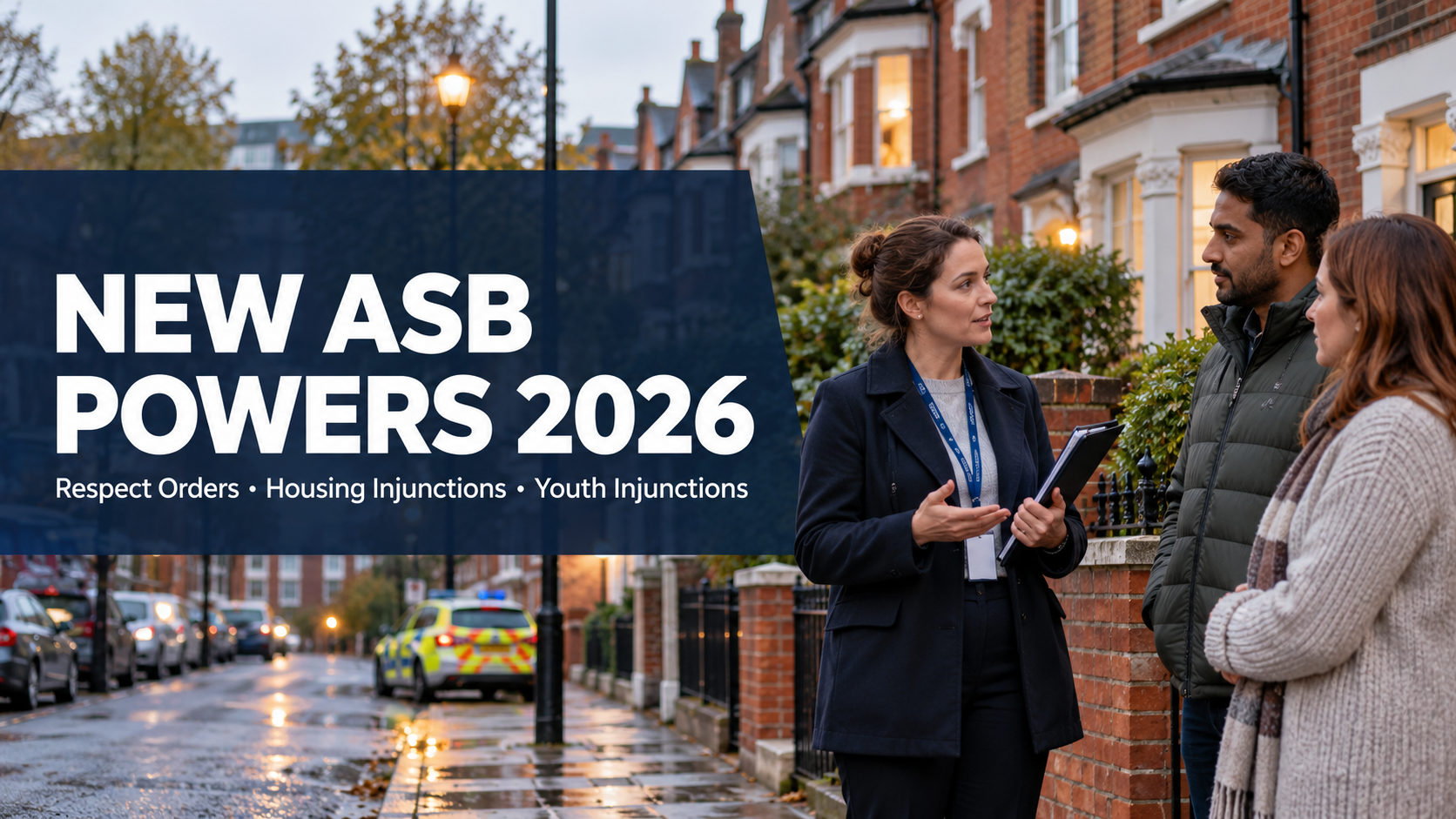
Anti-social behaviour can quickly make life unbearable for tenants and neighbours. Persistent noise, threats, vandalism, intimidation and abusive behaviour do not just affect one household—they can damage the safety and wellbeing of an entire community.
From 26 October 2026, new measures under the Crime and Policing Act 2026 will change how housing providers and public authorities can respond to anti-social behaviour. The reforms introduce three separate legal remedies: Respect Orders, Housing Injunctions and Youth Injunctions.
Here is a straightforward explanation of what they mean for landlords, letting agents and property managers.
Respect Orders for serious adult anti-social behaviour
Respect Orders are a new type of civil order for people aged 18 or over.
A court may grant an order where an adult has behaved—or threatened to behave—in a way that causes, or is likely to cause, harassment, alarm or distress.
The order can tell the person what they must stop doing. For example, they may be prohibited from entering a particular area, approaching named residents or taking part in specified behaviour.
It can also require them to take positive steps, such as attending:
- Drug or alcohol treatment;
- Anger-management sessions;
- Mental-health support; or
- Other programmes intended to address the reason behind their behaviour.
This means a Respect Order can protect residents while also helping to tackle the underlying causes of the problem.
Breaching a Respect Order is a criminal offence
One of the most important changes is what happens if the order is ignored.
A breach of a Respect Order without a reasonable excuse is a criminal offence. The police can arrest a person suspected of breaching an order, and the criminal court may impose a fine, community order, suspended sentence or imprisonment.
A conviction for breaching a Respect Order could also allow a landlord to consider using the absolute anti-social behaviour ground for possession. However, possession is not automatic. The correct legal process must still be followed, and landlords should obtain advice before taking action.
Housing Injunctions
Housing Injunctions are intended for housing-related anti-social behaviour involving adults.
They can be considered where someone’s behaviour is capable of causing nuisance or annoyance in a housing setting. This may include:
- Repeatedly threatening or abusing neighbours;
- Serious and persistent noise nuisance;
- Vandalism or deliberate damage;
- Bullying or intimidation;
- Misbehaviour in communal areas; or
- Behaviour that seriously interferes with another person’s enjoyment of their home.
The legal test for a Housing Injunction is different from the test for a Respect Order. A Respect Order deals with conduct causing harassment, alarm or distress, while a Housing Injunction retains the housing-specific test of nuisance or annoyance.
This is helpful because some behaviour can have a serious effect on neighbours even if it does not meet the higher threshold required for a Respect Order.
However, Housing Injunctions must be used proportionately. They should not be used to control ordinary disagreements, everyday living noise or harmless behaviour.
Youth Injunctions
Youth Injunctions apply to young people aged between 10 and 17.
These cases will be heard in the Youth Court. Before making an application, the relevant Youth Offending Team must be consulted.
The young person’s welfare, personal circumstances and any vulnerabilities must be considered carefully. Formal enforcement may sometimes be necessary, but early support and safeguarding should remain central to the process.
A Youth Injunction can prevent certain behaviour and require the young person to take part in support or rehabilitation programmes. It can normally remain in place for up to 12 months.
A risk assessment will be required
Before an application is made for any of these orders, the applicant will need to complete a proper risk assessment.
The assessment should consider:
- The risk to victims, witnesses and other residents;
- Whether the behaviour is likely to continue or become worse;
- Any vulnerabilities affecting the person responsible;
- Whether another form of support or intervention could help;
- The impact on the wider community; and
- Whether the proposed legal action is necessary and proportionate.
It is important to keep a written record of this assessment and the reasons for choosing a particular remedy.
Evidence remains extremely important
Housing providers cannot rely on general complaints alone. They will need clear evidence showing what happened, when it happened and how it affected other people.
Useful evidence may include:
- Incident diaries;
- Witness statements;
- Photographs and video recordings;
- Noise-monitoring evidence;
- Police incident or crime-reference numbers;
- Messages, emails or social-media posts;
- Repair records showing deliberate damage; and
- Records of previous warnings and attempts to resolve the problem.
Victims and witnesses should be kept informed and supported. Where someone is frightened about giving evidence, that concern should be identified at an early stage so appropriate arrangements can be considered.
Can private landlords apply for these orders?
Private landlords and letting agents should be careful about this point.
The legislation gives application powers to specific public bodies and qualifying housing providers. The definition of a housing provider mainly covers social housing organisations and certain public-sector landlords. An ordinary private landlord or managing agent will not usually be able to apply directly simply because they own or manage the affected property.
Private landlords can still play an important role by:
- Recording complaints properly;
- Supporting affected tenants;
- Reporting criminal behaviour to the police;
- Working with the local authority and other agencies;
- Taking appropriate action under the tenancy agreement; and
- Seeking legal advice about possession or other tenancy enforcement.
If anyone is in immediate danger, the police should be contacted straight away.
Choosing the correct remedy
In some cases, it may not be immediately clear whether a Respect Order or Housing Injunction is more appropriate.
The legislation allows a court to treat an application for a Respect Order as an application for a Housing Injunction, or vice versa, when the evidence supports a different remedy.
Even with this flexibility, housing providers should assess every case carefully and explain why the chosen order is necessary.
What should landlords and housing providers do now?
Before the reforms come into force, organisations dealing with residential property should:
- Review their anti-social behaviour policies;
- Train staff to recognise the three different remedies;
- Improve the way complaints and evidence are recorded;
- Introduce a clear risk-assessment procedure;
- Build working relationships with the police, councils and Youth Offending Teams;
- Make sure victims and vulnerable residents are supported; and
- Seek legal advice before beginning formal proceedings.
Final thoughts
The Crime and Policing Act 2026 provides stronger and more flexible ways to deal with anti-social behaviour.
Respect Orders will address more serious adult behaviour and carry criminal consequences if breached. Housing Injunctions will remain available for nuisance and annoyance connected with residential property, while Youth Injunctions will provide a separate approach for children and young people.
For landlords and property managers, early action is essential. Complaints should be taken seriously, evidence should be recorded properly and residents should not be left without support.
At Let-Buy-Invest Properties Ltd, we understand how damaging anti-social behaviour can be for residents, landlords and local communities. We can help property owners manage reports, maintain appropriate records and communicate with the relevant organisations.
This blog provides general information only and does not constitute legal advice. Professional advice should be obtained before starting possession or enforcement proceedings.
Short blog-listing summary
New anti-social behaviour powers take effect on 26 October 2026. We explain Respect Orders, Housing Injunctions and Youth Injunctions—and what private landlords, letting agents and housing providers should do when problems arise.