
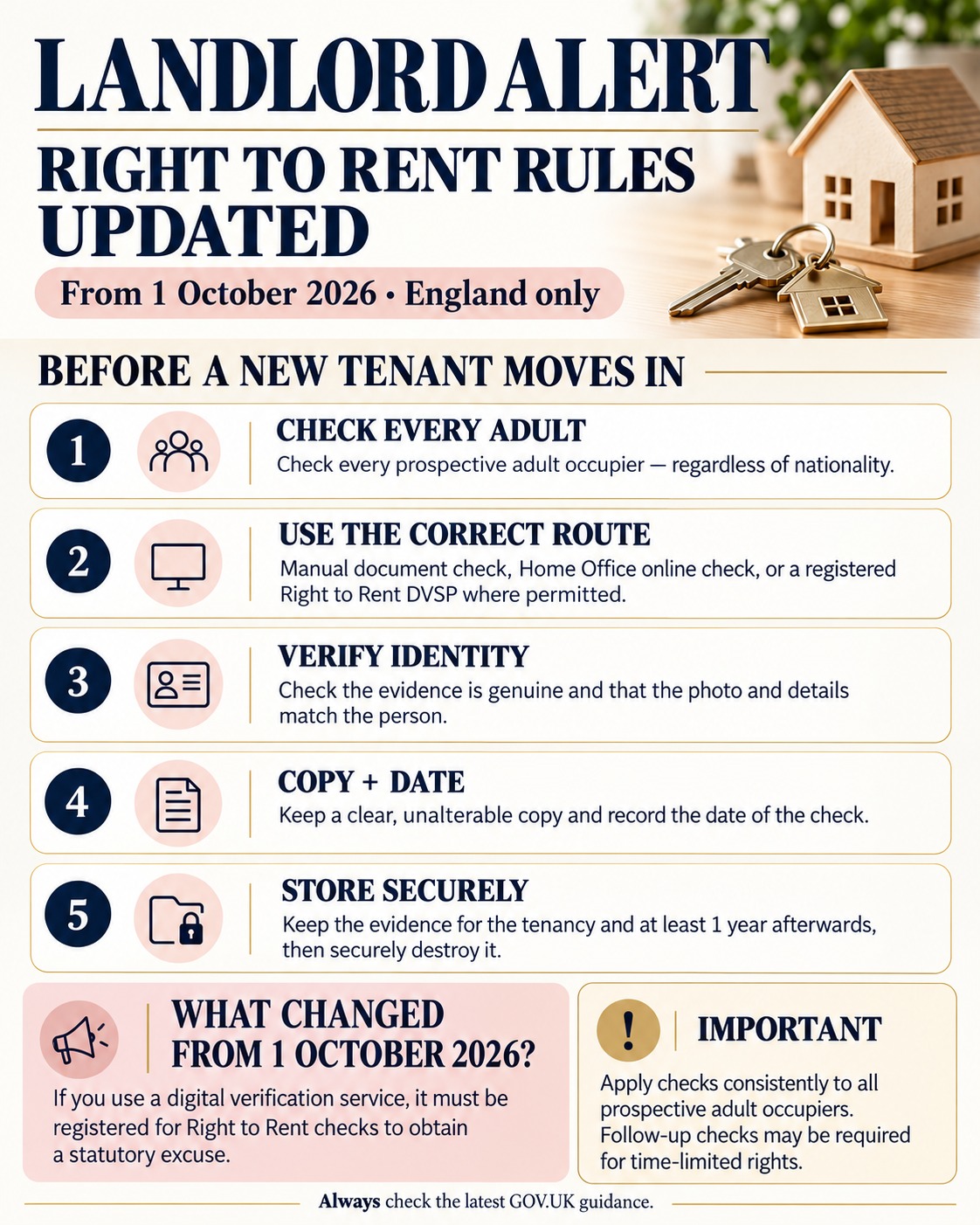
If you are a landlord or letting agent in England, Right to Rent checks are probably already part of your tenant onboarding process. However, the Home Office guidance changed on 1 October 2026, particularly around the use of digital identity-checking services.
Here is what landlords need to know in clear, practical terms.
Who needs to be checked?
Before agreeing a new tenancy, landlords must check every adult aged 18 or over who will live at the property.
This includes people who may not be named on the tenancy agreement. Checks must be completed regardless of the person’s nationality—you cannot assume that somebody has a Right to Rent simply because they are British or Irish.
The same process should be applied fairly to everyone. Choosing who to check based on their name, accent, appearance or perceived nationality could amount to unlawful discrimination.
What changed in October 2026?
The most important change relates to landlords who use a digital company to verify a tenant’s identity.
Using a digital service is optional. You can still carry out an appropriate manual document check or use the official Home Office online service.
However, if you choose digital verification, the provider must now be registered with the Office for Digital Identities and Attributes and specifically approved to carry out Right to Rent checks.
Do not assume that every tenant-referencing or identity-checking company meets this requirement. Ask the company to confirm:
- The name of the registered digital provider carrying out the check;
- That it is registered to provide Right to Rent checks; and
- That its report meets the current Home Office requirements.
Even when a digital provider is used, the landlord remains responsible for making sure the check has been completed properly.
How can a Right to Rent check be completed?
There are several different routes, depending on the tenant’s documents and immigration status.
Manual document check
You can check an acceptable original document. You must make sure the document appears genuine, belongs to the person presenting it and confirms their Right to Rent.
Compare the photograph and date of birth with the prospective tenant. Make a clear copy, record the date of the check and store the evidence securely.
Home Office online check
Someone with an eVisa or digital immigration status may give you a Right to Rent share code beginning with the letter “R”, together with their date of birth.
You must use these details directly through the official Home Office online checking service. A screenshot shown by the prospective tenant is not enough.
Registered digital verification service
A registered provider may be used for certain digital identity checks, including permitted checks involving British and Irish passports or passport cards.
You must obtain the provider’s complete report and confirm that the photograph and personal details match the person who intends to rent the property.
Landlord Checking Service
In some situations, the person’s Right to Rent cannot be confirmed through the standard routes. This may happen when they have an outstanding immigration application or appeal.
The landlord may then need to request confirmation through the Home Office Landlord Checking Service.
Do not forget the timing
For someone with an unlimited Right to Rent, the check may be carried out at any time before the tenancy agreement is entered into.
For a person with a time-limited Right to Rent, the check must normally be completed no earlier than 28 days before the tenancy agreement is entered into.
A follow-up check may also be required. Landlords should record the deadline as soon as the initial check is completed so that it is not overlooked.
Keep your evidence
Keep a clear copy of the documents, online result or digital provider’s report, together with the date of the check.
The evidence must be stored securely throughout the tenancy and for at least one year after the tenancy ends. It should then be securely destroyed.
Good record-keeping is essential. If the Home Office ever asks for evidence, you should be able to show exactly what was checked, when it was checked and which method was used.
Why does this matter?
A properly completed Right to Rent check can provide a landlord with a statutory excuse against a civil penalty if an occupier is later found not to have permission to rent.
The penalties can be serious—up to £10,000 for a first breach involving an occupier and £20,000 for a repeat breach within three years.
Taking a few extra minutes to follow the correct procedure could prevent a costly problem later.
Need support with your rental property?
At Let-Buy-Invest Properties Ltd, we understand that landlords have an increasing number of legal and administrative responsibilities.
We support landlords with professional property management, organised tenant onboarding and clear compliance records—helping you protect your property while providing a reliable service to your tenants.
Contact Let-Buy-Invest Properties Ltd to discuss how we can support you with the day-to-day management of your rental property.
This article is for general information only and does not constitute legal advice. Landlords and letting agents should always check the latest Home Office guidance.